From Pillar to Presence: The Roar that Protected Devotion -by: Sharmila Sanka
Published on April 24, 2026
From Pillar to Presence: The Roar that Protected Devotion
By: Sharmila Sanka
There are moments in creation when the Divine does not merely bless, it erupts to restore balance. The incarnation of Lord Narasimha stands as one such unparalleled moment, where divinity took a form never seen before, to destroy the wicked and protect unwavering devotion.
The tyrant king Hiranyakasipa, driven by insatiable greed and a relentless desire for immortality, performed severe penance, and secured powerful boons. Armed with these protections, he believed he had conquered death itself. His arrogance grew boundless. He defied the cosmic order, forbade the worship of Lord Narayana, and demanded that all revere him as supreme.
Yet, within his own palace lived a quiet revolution-his son, Prahlada. Prahlada, untouched by ego or fear, was immersed in the divine name of Sri Hari. No teacher had instructed him; no circumstance had influenced him. His devotion flowed naturally, as though every cell in his being resonated with Narayana. Despite repeated warnings, and punishments from his father, Prahlada remained steadfast. His faith was not defiance; it was truth.
“How can one harm the one who lives in God?”
“How can fear enter a heart where the Divine resides?”
Time and again, as Hiranyakasipa subjected Prahlada to unbearable trials, an unseen force protected the child. That force was none other than Sri Hari Himself, responding not to ritual, but to pure, unshaken devotion. In a final confrontation, Hiranyakasipa, consumed by rage, challenged Prahlada’s belief in Sri Hari's omnipresence. Pointing to a pillar, he demanded, “Is your Hari present here too?” With unflinching conviction, Prahlada replied, “Yes.”
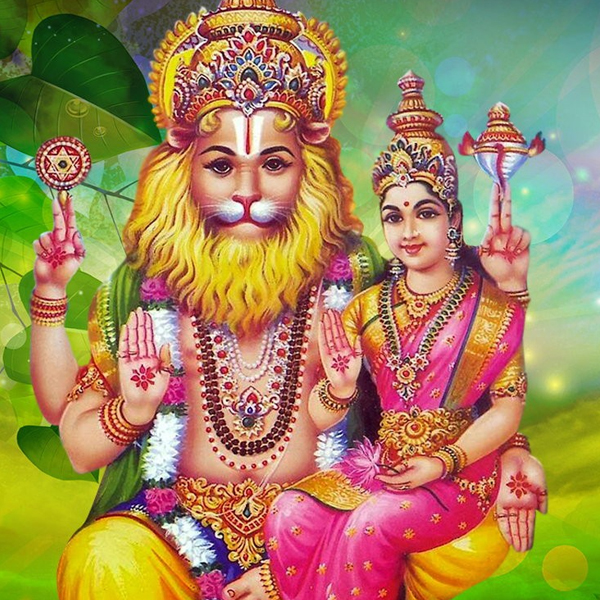
In that very instant, the king struck the pillar and what followed was not just a revelation, but a cosmic declaration. From within the pillar emerged a form that transcended all definitions—a being neither man nor beast. With the face of a lion and the body of a human, Lord Narasimha manifested-fierce, radiant, and unstoppable.
At twilight, neither day nor night
On the threshold, neither indoors nor outdoors
With no weapon, but His own nails
Neither human nor animal
In perfect alignment with the boon’s conditions, Narasimha destroyed Hiranyakasipa, tearing apart not just a body but the very illusion of invincibility born of ego. Yet, even after the demon was vanquished, the intensity of Narasimha’s form shook the universe. The devas trembled, and even Goddess Lakshmi hesitated to approach Him. The fury was not mere anger. It was the cosmic force of righteousness unleashed.
Who, then, could calm the Lord? Only the one for whom He came.
Prahlada, the child-devotee, approached Narasimha with folded hands and a heart overflowing with love. With a series of heartfelt prayers as described in the Bhagavata Purana, he did not seek to pacify the fierce protector, but lovingly awakened the compassionate Lord within.
Ugram Vīram Mahāviṣṇum
Jvalantam Sarvato Mukham
Nṛsiṁham Bhīṣaṇam Bhadram
Mṛtyor Mṛtyum Namāmyaham
“I bow to Lord Narasimha-fierce, heroic, and all-pervading; the blazing one who protects from all directions; the terrifying yet auspicious Lord who is the destroyer of death itself.”
It was his pure devotion, humility, and surrender that transformed the Lord’s fierce form into compassion.
And in that moment, the roar softened into grace. Narasimha’s eyes filled with affection, His expression transformed into serenity, and He lifted Prahlada onto His lap granting him blessings beyond measure. The Divine, who had appeared in unimaginable ferocity, now revealed His boundless tenderness.
Since that sacred moment, Lord Narasimha has been worshipped as the remover of deep-seated fears, protector against unseen adversities, and the embodiment of divine justice. Participating in or performing the Narasimha Homam is believed to invoke His grace bringing peace, protection, and prosperity.
But beyond the ritual lies a deeper message. The Avatar does not descend merely to destroy evil but to awaken humanity. To remind us that devotion, when pure and unwavering, becomes a force that even the Divine responds to. That the Divine is not distant but present, in every pillar, every breath, every heartbeat. Prahlada did not just witness God. He lived God. And Narasimha did not just emerge from a pillar. He revealed that the Divine resides everywhere… waiting to manifest when faith calls without fear.