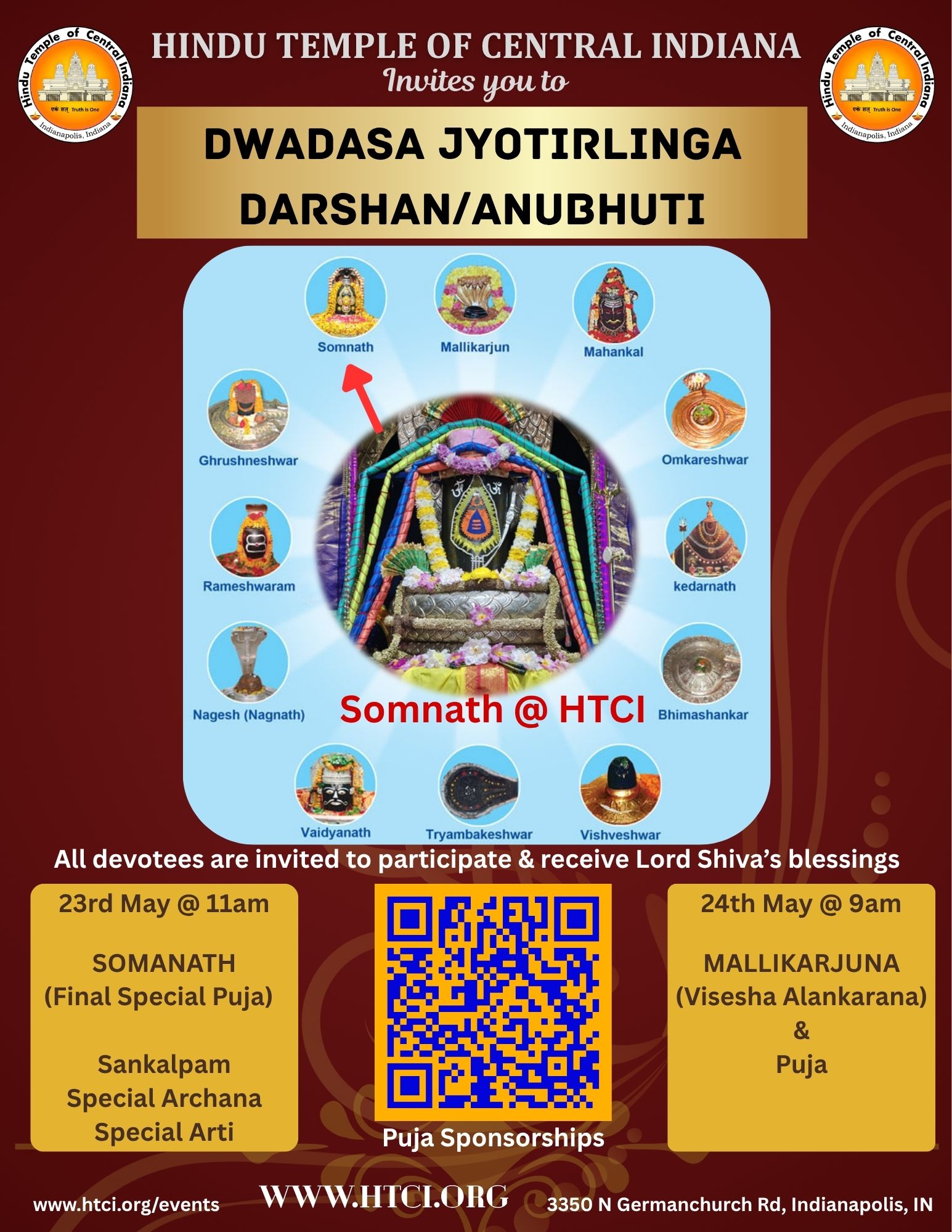
DWADASA JYOTIRLINGA DARSHAN, ANUBHUTI & ALANKARAM
Saturday, May 23, 2026 - Sunday, June 6, 2027
11:00 AM - 8:00 PM ET
Main Prayer Hall
There are twelve Jyotirlingas and they are the major places of worship of Shiva. They materialised in a radiant form. The thirteenth pinda is known as the kalpinda. The pinda (Subtle body) which has crossed the limits of kal (Time), is known as kalpinda.
THE MEANING OF JYOTIRLINGA
The all-pervading Brahmatmalinga or all-pervading light. In the Taittiriya Upanishad, the twelve Principles of Brahma, Maya, the jiva, the mind, intellect, subconscious mind, ego and the Panchamahabhutas have been referred to as the twelve Jyotirlingas. The twelve sections of the Shivalinga. In the Yadnyavedi (Pit where the ritual of sacrificial fires is performed), the shalunka represents the pit of the fire and the linga the flame of the fire. A representation of the twelve Adityas (Species of Deities who are designated into groups). The sites of eruption of fire from the dormant volcanoes. Since Yama, the master of southern direction is a subordinate of Shankar, south becomes the direction of Shankar. The Jyotirlingas are south-oriented, meaning, the opening of their shalunkas face southwards. Most temples do not face the southern direction. When the opening of the shalunka faces the south, its pinda possesses more spiritual energy; while the pinda with the opening of the shalunka facing north possesses lesser energy.
SPIRITUAL SIGNIFICANCE
We should select an appropriate Jyotirlinga and perform Abhishek on that Jyotirlinga for example, Mahankal is charged with Tama predominant energy, Naganatha is in Harihar form and is Sattva-Tama-predominant and Tryambakeshwar is three components-oriented (also known as Avadhut).